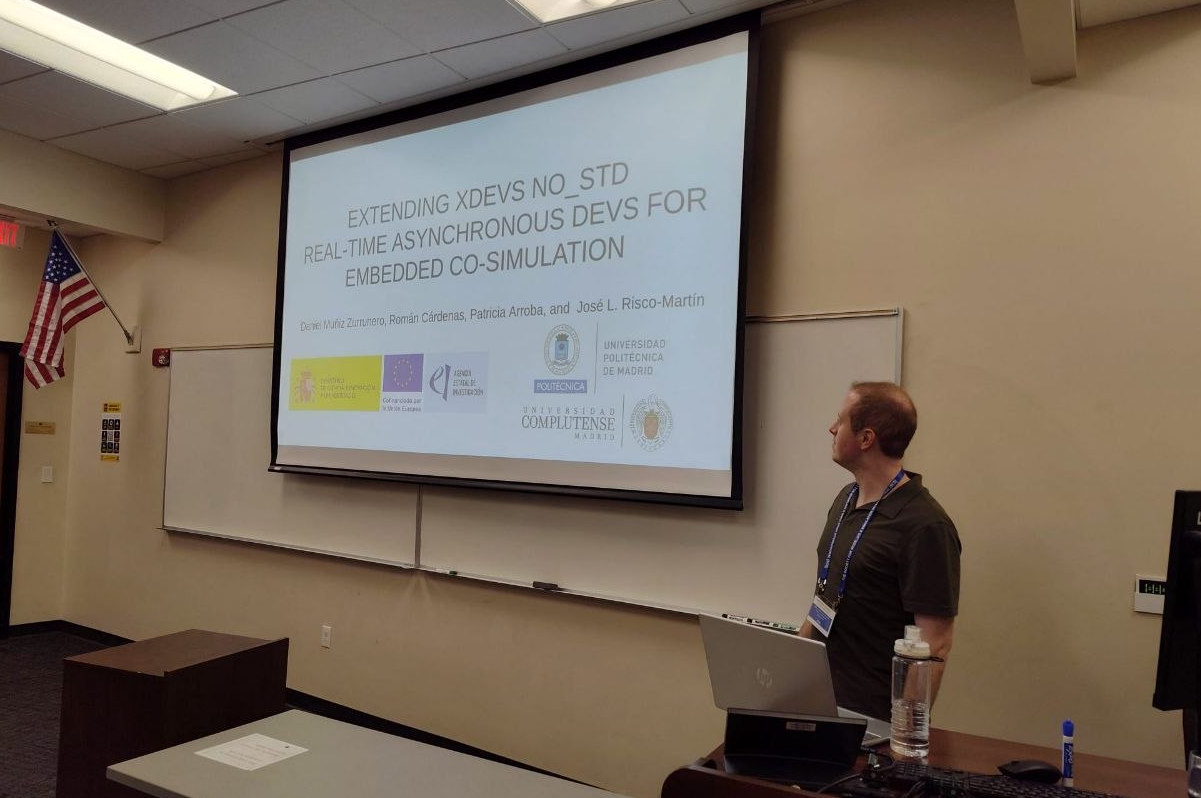
The researcher Daniel Muñiz Zurrunero has taken part in the Annual Modeling and Simulation Conference (ANNSIM 2026), held this year in Orlando, Florida, where he presented two scientific papers and a communication linked to the research lines of the Center for Computational Simulation (CCS) and the WATER-SUSTAIN project.
His participation included the presentation of two scientific papers accepted at the conference, as well as a contribution to the PhD Colloquium focused on the doctoral work Daniel is currently developing. These contributions strengthen the CCS’s presence in the field of modeling and simulation of complex systems, with special attention to co-simulation in embedded systems, the DEVS formalism, and IoT architectures applied to early warning systems.
Real-time asynchronous co-simulation for embedded systems
Section titled “Real-time asynchronous co-simulation for embedded systems”The first paper presented, entitled “EXTENDING XDEVS NO_STD: REAL-TIME ASYNCHRONOUS DEVS FOR EMBEDDED CO-SIMULATION”, addresses the extension of xDEVS no_std to enable real-time asynchronous co-simulation on low-resource embedded systems, allowing their validation and optimization at each phase of design and application.
This work contributes to the creation and application of methodologies that make it possible to integrate simulated models and real components, facilitating the development of cloud-edge infrastructures in scenarios where efficiency and reliability are essential.
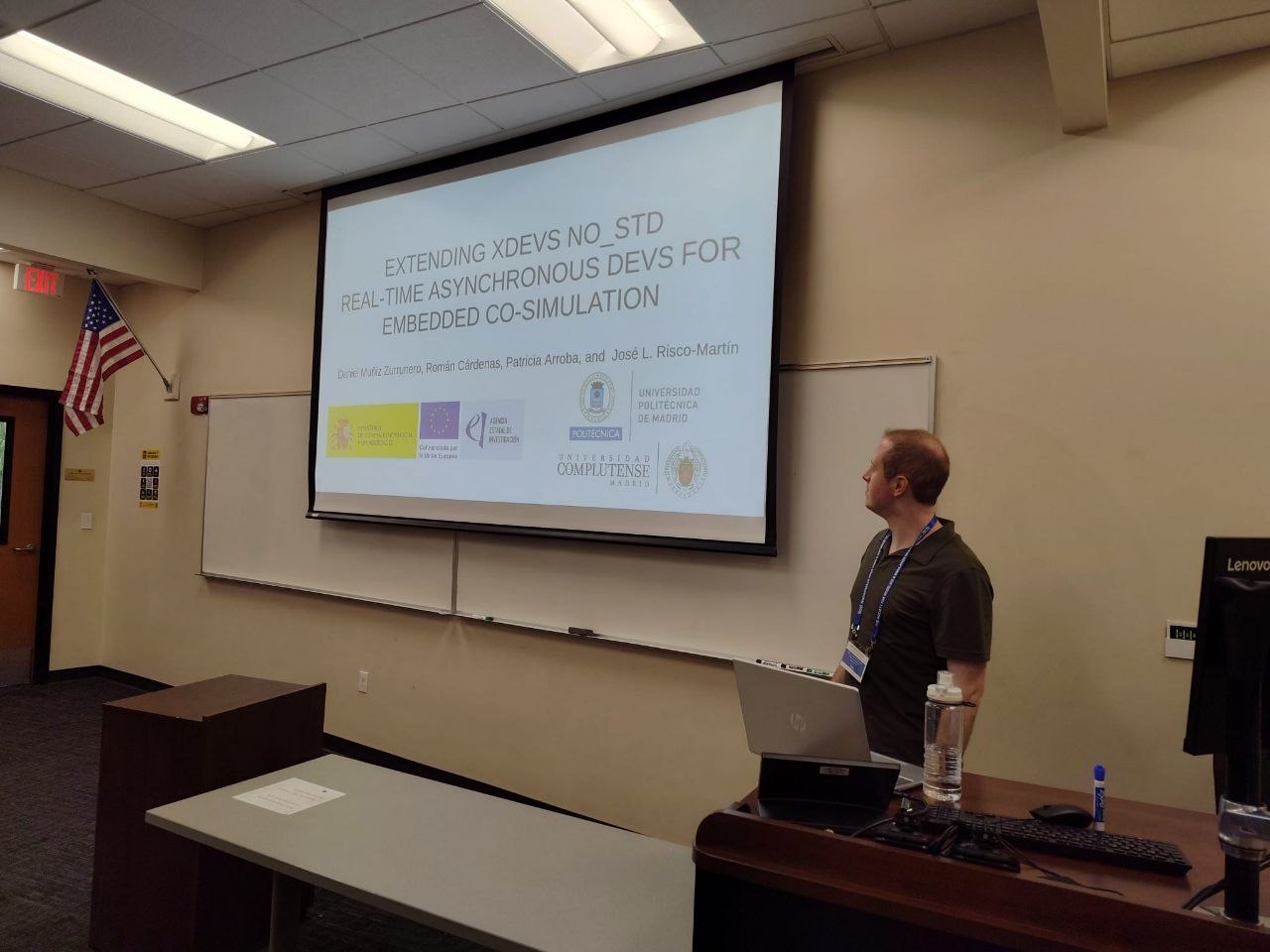 Daniel Muñiz during the presentation of “EXTENDING XDEVS NO_STD: REAL-TIME ASYNCHRONOUS DEVS FOR EMBEDDED CO-SIMULATION”
DEVSFORGE: visual modeling for xDEVS
Section titled “DEVSFORGE: visual modeling for xDEVS”The second paper presentation, “DEVSFORGE: A VISUAL MODELING ENVIRONMENT FOR XDEVS”, introduced DEVSForge, a visual modeling environment for xDEVS aimed at facilitating the creation, modification, and combination of DEVS models. The tool seeks to reduce the barrier to entry to the DEVS formalism through a graphical interface that enables users to work with simulation models in a more intuitive way, while maintaining the formal rigor required for its application in research and technological development.
Both papers include Daniel Muñiz Zurrunero, Román Cárdenas Rodríguez, and Patricia Arroba García as authors, consolidating the presence of the department and the CCS in leading international forums. The articles were produced in collaboration with researchers from the Complutense University of Madrid (UCM), thereby strengthening ties with leading groups in the field.
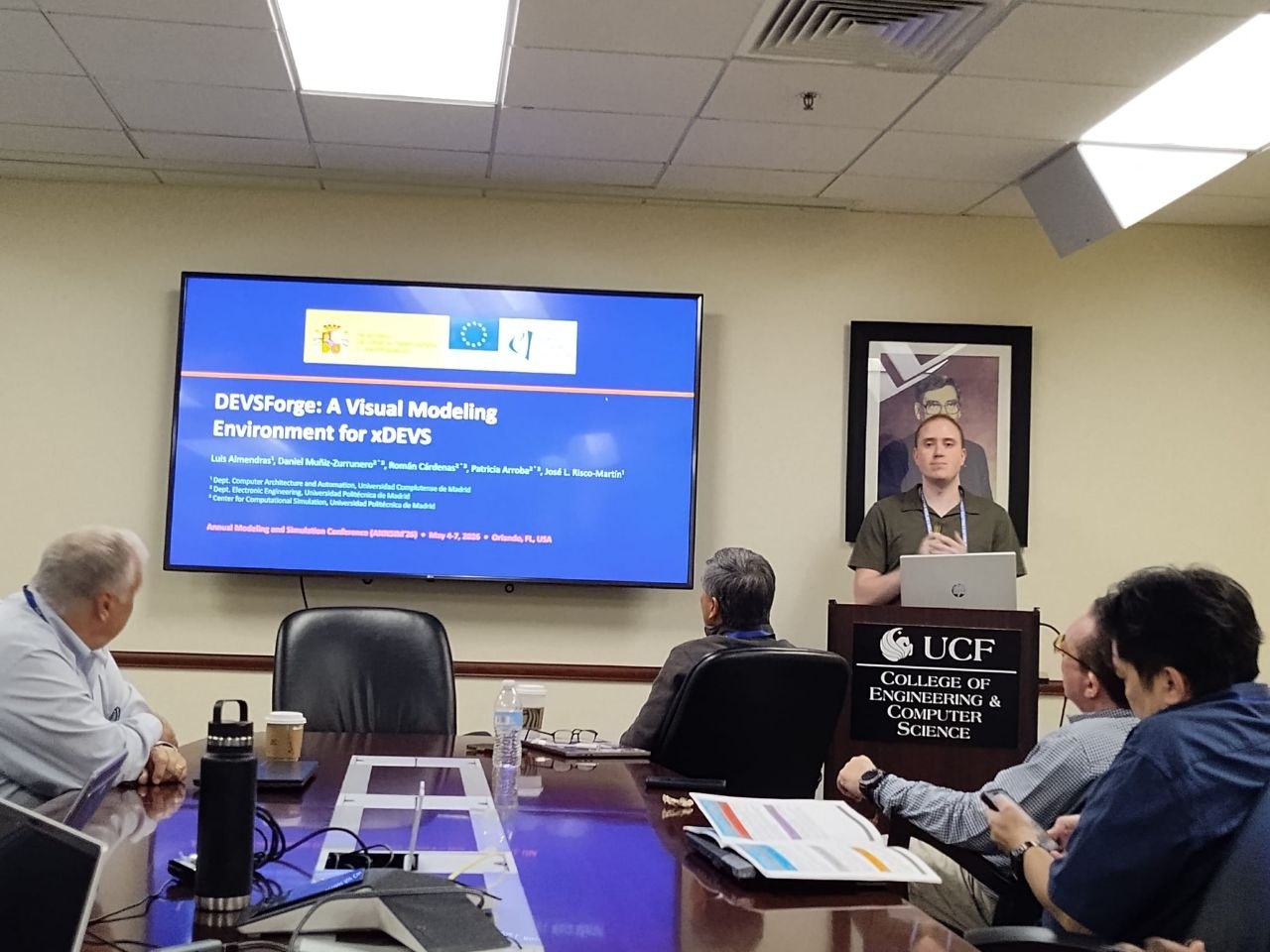 Daniel Muñiz during the presentation of “DEVSFORGE: A VISUAL MODELING ENVIRONMENT FOR XDEVS”
A co-simulation methodology for IoT early warning systems
Section titled “A co-simulation methodology for IoT early warning systems”In addition to the two scientific presentations, Daniel took part in the ANNSIM 2026 PhD Colloquium with the contribution “A DEVS-BASED CO-SIMULATION METHODOLOGY FOR IOT EARLY WARNING SYSTEMS”, focused on a new DEVS-based co-simulation methodology he is developing as part of his doctoral thesis.
The proposal is aimed at the design and deployment of IoT early warning systems for bio-pollutants in freshwater. These are critical systems due to sustainable development being limited by the lack of validation and optimization strategies in such changing natural environments.
Through the use of DEVS for the creation and application of co-simulation strategies, the thesis introduces a new methodology enabling the gradual validation and optimization of the infrastructure across all phases of design, deployment, and operation, breaking through current limitations and allowing sustainable, standardized, and risk-free development.
Participation in the PhD Colloquium also made it possible to place the doctoral research in an international context, fostering the exchange of ideas with other researchers and specialists in the field.
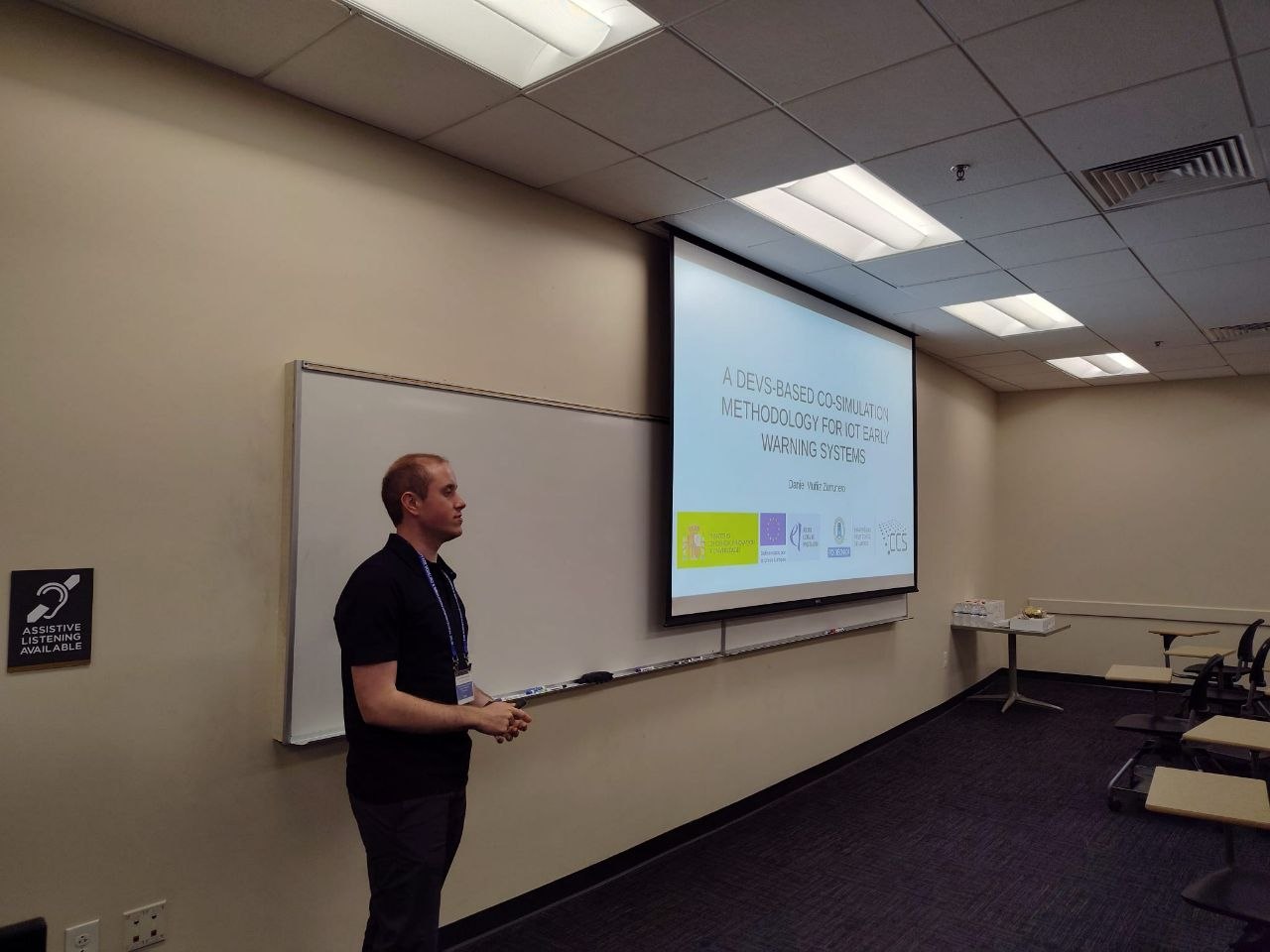 Daniel Muñiz during the PhD Colloquium
With these three contributions, the CCS strengthens its contribution to the advancement of co-simulation applied to the development of complex systems, highlighting the role of DEVS as a methodological foundation for the design, evaluation, and integration of edge-cloud infrastructure and IoT applications.
